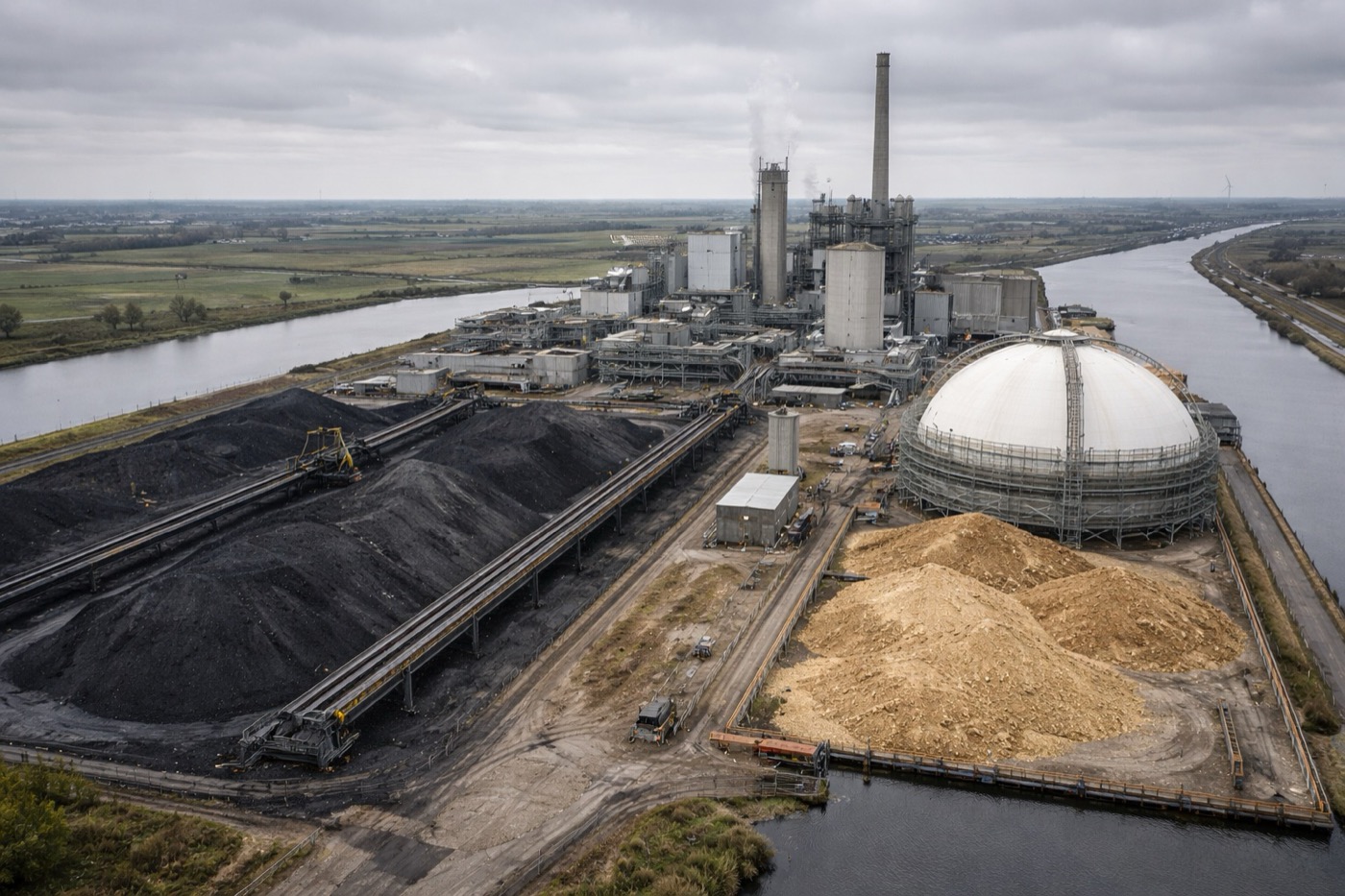
Transitioning from coal to biomass co-firing is not a single procurement decision — it is a project. Procurement managers who treat the first biomass cargo as a straightforward substitute purchase typically encounter avoidable complications: specification mismatches, documentation gaps, handling infrastructure surprises, and cost structures that look different once the full landed cost is accounted for. Those who approach the transition with a structured framework move from first cargo to ongoing supply program with significantly less friction.
This guide is written for the procurement manager who has been tasked with exploring or implementing a coal-to-biomass transition — whether for an industrial CHP facility, a utility-scale co-firing station, or a district heating plant. It covers the technical, commercial, and compliance steps in sequence, with specific reference to PKS as the primary candidate biomass for many European co-firing applications.
Step 1: Establish Technical Compatibility
Before issuing any RFQ, procurement managers should commission or obtain an internal assessment of their boiler's technical compatibility with PKS co-firing. The key parameters to review are boiler type, fuel handling and feeding systems, milling configuration (if applicable), ash handling capacity, and any existing emission monitoring obligations.
For fluidised bed combustors and stoker boilers, PKS is typically compatible at co-firing ratios of 10–30% with minimal or no modification. The material's size distribution (5–50mm nominal), ash characteristics (fusion temperature >1,200°C), and combustion behaviour are well-matched to these boiler configurations. For pulverised fuel boilers designed primarily for wood pellets, PKS co-firing is feasible at lower ratios (up to 15%) but requires review of mill grinding parameters and may necessitate minor fan and classifier adjustments. Engaging your boiler OEM or a specialist combustion engineer at this stage, with the PKS technical specification in hand, will produce a clear and bankable answer on compatibility and any required capex.
Simultaneously, assess your port and site receiving infrastructure. PKS requires covered storage to prevent moisture uptake and is handled by standard grab crane or pneumatic conveying systems — the same equipment used for coal. If your site currently handles coal, the primary infrastructure question is whether covered biomass storage is available. Uncovered stockpiling of PKS for extended periods is not advisable and will materially degrade calorific value.
Step 2: Structure Your First Trial Cargo
A trial cargo — typically 3,000–10,000 MT — allows both parties to validate specifications, test handling and combustion performance, and establish a reference quality dataset before committing to a long-term supply agreement. For first-time PKS buyers, the trial cargo is also the opportunity to run your compliance documentation through your internal audit process and identify any gaps before your first full cargo.
Trial cargos should be purchased on a CIF basis (your discharge port) with quality determined at the discharge port by independent survey. The survey should cover net calorific value (as received and air dried), moisture content, ash content, total sulphur, and bulk density. Specifying minimum NCV of 16.5 MJ/kg as received and maximum moisture of 22% are conservative specifications that a well-managed supply program should consistently satisfy. Reference the full specification table on the product page for recommended specification thresholds by application.
The commercial structure for a trial cargo should include a payment term that protects both parties: 10–15% advance with balance payable against bill of lading documents or within a short credit window is standard in the market. Avoid committing to a fixed-price annual program before the trial cargo performance has been reviewed and validated internally.
Step 3: Build Your Compliance Documentation Framework
RED II compliance documentation for biomass co-firing must be established before your first cargo is used for heat or power generation that will attract renewable energy support or be reported against renewable obligations. The documentation framework has two components: the supplier-provided certification package and your own internal reporting and record-keeping system.
From your supplier, you require a valid ISCC EU chain-of-custody certificate stack, a GHG calculation worksheet demonstrating the required percentage saving against the fossil fuel comparator, a sustainability declaration conforming to the format required by your national competent authority, and an independent survey report confirming cargo quality. Confirm with your compliance team which specific format and data fields your national authority requires — these vary between the Netherlands, Germany, Poland, and Denmark.
Internally, you should establish a cargo-level documentation register that archives all compliance documents for each cargo received, cross-referenced against the relevant billing period for your support scheme claims. Most national regulators conduct periodic audits of biomass co-firing installations and will request access to this register. Having it structured and current before your first audit notice arrives is considerably less stressful than assembling it retrospectively.
Total Cost of Ownership: The Correct Comparison Framework
The naive comparison between PKS and coal procurement cost is cost-per-tonne. The correct comparison is total cost of ownership per MWh of heat or power generated, accounting for calorific value, handling costs, compliance costs, and the avoided carbon cost — or in support scheme contexts, the incremental subsidy value of renewable generation. For most European co-firing operators in 2026, this calculation firmly favours biomass at current ETS carbon prices above €60/tonne, with PKS delivering a lower total cost per MWh than coal even before support scheme revenue is included.
For buyers ready to move from analysis to procurement, PKSEurope can provide a pre-formatted TCO comparison model populated with your boiler parameters and current CIF pricing. Contact our supply team to request the model and a current price indication for your discharge port.
Start Your Coal-to-Biomass Transition with a Structured Trial Cargo
PKSEurope provides trial cargo programs specifically designed for first-time PKS buyers: full documentation, independent survey, and ongoing supply support from first cargo to annual program.
Discuss Your Trial Cargo