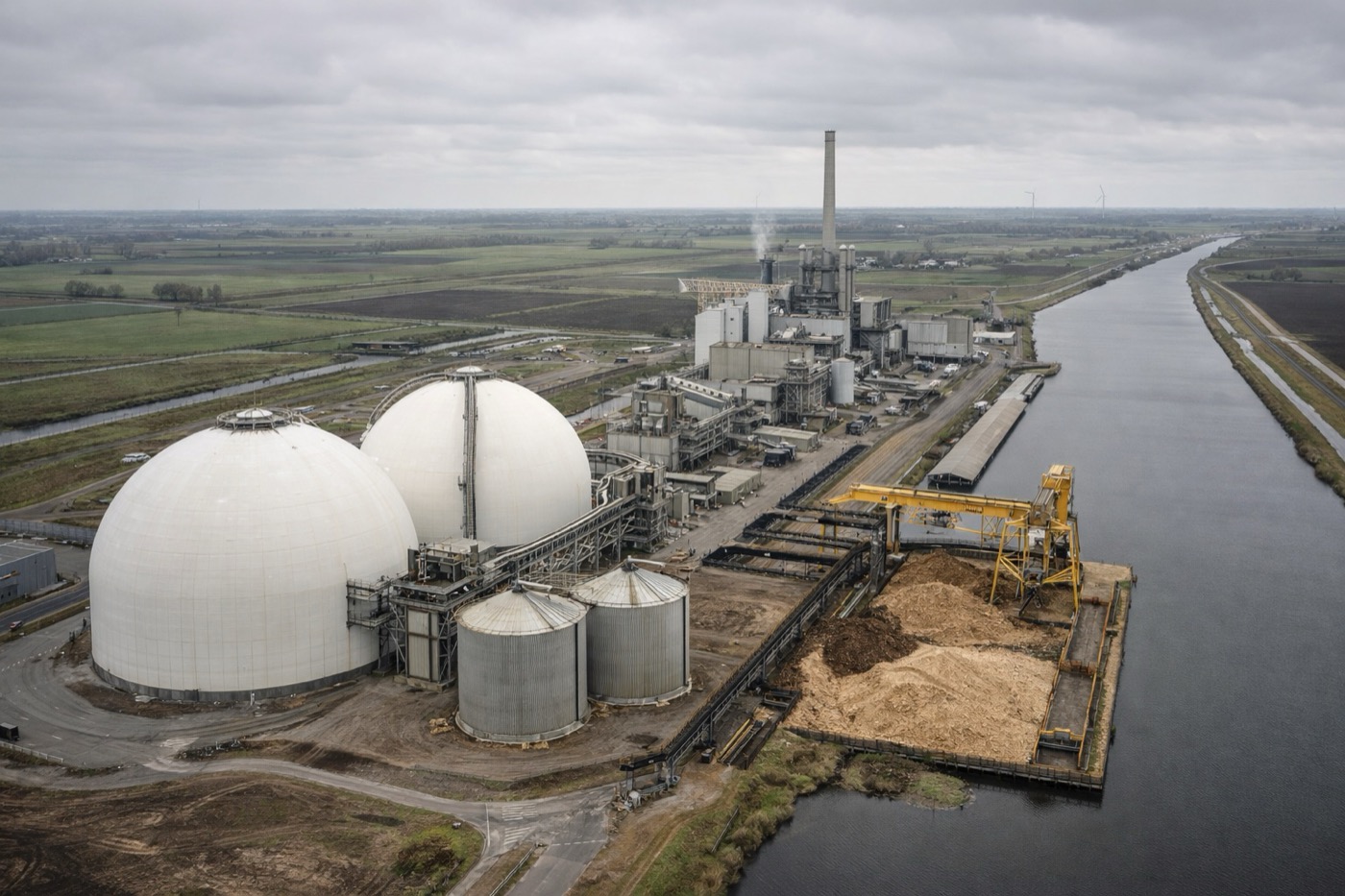
For Dutch energy buyers considering Palm Kernel Shell as a co-firing fuel, the central commercial question is straightforward: does PKS qualify for SDE++ subsidy support, and if so, what documentation must a supplier provide to make that subsidy claim stick? The answer to the first question is yes — certified PKS from Malaysia and Indonesia qualifies for SDE++ under the biomass co-firing and dedicated biomass heat categories. The answer to the second requires understanding exactly how the Dutch SDE++ framework sits within the broader EU RED II structure, and what your supplier must deliver with every cargo.
This article covers the mechanics of SDE++ for biomass buyers, PKS's specific qualification pathway under RED II Annex IX Part B, the GHG savings threshold your supply chain must satisfy, and what the application and ongoing reporting process looks like for Dutch industrial buyers.
What Is SDE++?
SDE++ — Stimulering Duurzame Energieproductie en Klimaattransitie, or Stimulation of Sustainable Energy Production and Climate Transition — is the Netherlands' primary renewable energy subsidy scheme. Administered by the Netherlands Enterprise Agency (RVO), it provides a feed-in premium to producers of renewable electricity and renewable heat, bridging the gap between the cost of producing energy from sustainable sources and the market price of that energy.
SDE++ operates through twice-yearly tender rounds, typically in spring and autumn. Applicants submit bids specifying a base amount (the subsidy rate they request) below a maximum category-specific rate published by RVO. Lower bids rank higher and are awarded first, with the scheme running until the annual budget is exhausted. Subsidy periods run for 12 to 15 years depending on the category, providing long-term revenue certainty for biomass installations.
For biomass co-firing in coal or gas plants — the most common configuration for PKS buyers in the Netherlands — the relevant SDE++ categories are co-firing of sustainable biomass with coal (MEI code: BMK) and dedicated biomass combustion for heat or combined heat and power (MEI codes: BMWh, BMWKK). Each category has its own maximum base amount, which RVO updates annually based on energy market conditions and cost modelling.
PKS Under RED II Annex IX Part B: The Qualification Pathway
SDE++ subsidy for biomass is conditional on the fuel meeting the sustainability criteria set out in EU RED II Article 29. The Netherlands has transposed RED II into national law through the Wet milieubeheer and associated RVO implementing regulations, which reference the EU framework directly. To qualify for SDE++ subsidy, a biomass fuel must be certified under an EU-recognised voluntary scheme — most commonly ISCC EU, SBP, or MSPO with ISCC linkage.
PKS — the hard shell of the palm kernel, separated as a byproduct at crude palm oil mills — is classified as an agricultural residue under RED II Annex IX Part B. This classification has two important consequences for Dutch buyers. First, Annex IX Part B biomass is exempt from the full set of land sustainability criteria that apply to purpose-grown energy crops under Article 29.2 through 29.7. PKS does not require land-use change analysis in the same way that dedicated energy crops do, because it is a processing residue rather than a cultivated crop. Second, Annex IX Part B biomass still requires a GHG lifecycle saving calculation, and that calculation must be documented and certified.
The Annex IX Part B classification makes PKS one of the cleaner qualification pathways in the SDE++ biomass framework — fewer exclusion criteria to satisfy, more straightforward certification audit scope, and a well-established certification infrastructure already operating at scale across Malaysian and Indonesian palm oil supply chains.
GHG Savings Threshold: What Your Supply Chain Must Achieve
RED II Article 29.10 sets the minimum GHG saving requirement for biomass used in existing electricity and heat installations. From 2026, installations that began operation before July 2014 must demonstrate a minimum 70% lifecycle GHG saving compared to the fossil fuel comparator. Installations that began operation between July 2014 and December 2020 are subject to the same 70% threshold. New installations (post-2021) must achieve 80%.
For PKS sourced from certified Malaysian supply chains, the typical calculated GHG saving falls in the range of 70–82%, depending on the specific mill's energy profile, transport distance, and the calculation methodology applied. This means most certified PKS supply programs satisfy the 70% threshold, but buyers with newer installations facing the 80% threshold should verify their supplier's GHG calculation specifically, rather than relying on category-level estimates.
The GHG calculation for PKS co-firing covers five components: extraction and processing of the raw material at the mill (including any palm kernel expeller process energy); transport from origin mill to port of export; ocean freight from origin port (typically Port Klang, Pelabuhan Tanjung Pelepas, or Belawan) to the Dutch receiving port (typically Rotterdam or Amsterdam); inland transport to the installation; and combustion emissions, which for biomass are treated as zero under the EU methodology (the carbon in biomass is assumed to return to the atmosphere in a closed biological cycle).
Your supplier should provide a completed GHG calculation worksheet using the Annex V or Annex VI methodology with every cargo, signed by their ISCC- or SBP-certified auditor. RVO requires this documentation to be retained and made available for spot audit throughout the subsidy period.
The SDE++ Application Process for Biomass Buyers
Applying for SDE++ subsidy as a biomass installation operator requires completing the online application through the RVO eLoket portal during an open tender round. The application covers the installation's technical specifications (installed capacity, expected annual production, fuel type and estimated consumption), the proposed base amount, and confirmation that the fuel will meet RED II sustainability criteria.
At application stage, RVO does not require you to submit certification documents for your specific supply program — this comes later. What you must confirm is that your fuel type is within the eligible biomass categories and that you have a credible pathway to meeting the sustainability criteria. For PKS, this means confirming the Annex IX Part B classification and indicating your intended certification scheme (typically ISCC EU or SBP).
Once a subsidy award is made, the production phase begins. For every production period (typically quarterly), you must submit a declaration to RVO confirming the volume of biomass consumed and the corresponding renewable energy produced. With each quarterly declaration, you are required to attach sustainability documentation: certification certificates covering all origin mills, chain-of-custody documentation, and GHG calculation worksheets. For co-firing installations, this also requires metering data demonstrating the proportion of PKS co-fired versus primary fuel.
RVO conducts periodic audits of SDE++ declarations, including supply chain document checks. Installations found to have consumed non-qualifying biomass face clawback of subsidy payments, so robust documentation from your PKS supplier is not a formality — it is a financial risk management requirement.
What to Request From Your PKS Supplier
Dutch buyers operating under SDE++ should structure their supply agreements to require the following documentation for each cargo:
- Valid ISCC EU, SBP, or MSPO+ISCC certification certificate for each origin mill, showing current validity and scope covering PKS as a certified product
- Chain-of-custody certificate from mill to vessel, issued under the relevant scheme
- GHG calculation worksheet (Annex V or Annex VI methodology) showing the calculated saving percentage for that specific cargo's origin and transport profile
- Sustainability declaration signed by the supplier, referencing RED II Article 29 compliance
- No-deforestation attestation covering the mill's sourcing area
- Bill of lading identifying the biomass as PKS and referencing the certification scheme and certificate number
- Independent survey report (SGS, Bureau Veritas or equivalent) covering moisture, calorific value, and ash content
For Dutch buyers specifically, it is worth confirming with your supplier whether their GHG calculation uses Dutch-specific transport assumptions (origin to Rotterdam rather than a generic European port), as the calculation is sensitive to the final transport leg. A cargo calculated to Rotterdam will typically show a marginally higher saving percentage than one calculated to a Baltic destination due to shorter ocean freight distance.
Looking Ahead: SDE++ Biomass Policy Under Review
The Dutch government's biomass policy has been subject to political scrutiny since the SER Biomassa report in 2020 and successive parliamentary motions questioning the role of imported biomass in the energy transition. The current policy direction has moved toward restricting SDE++ support for large-scale biomass heating and electricity — particularly wood pellets in dedicated plants — while maintaining support for biomass co-firing and industrial heat in sectors without near-term electrification alternatives.
For PKS buyers, the relevant signal is that Annex IX Part B agricultural residues — including PKS — have consistently been treated more favourably in policy discussions than primary woody biomass. The classification as a processing residue, combined with strong GHG savings performance and established certification, places PKS in a more defensible position than wood pellets as biomass subsidy policy evolves. However, buyers structuring long-term procurement agreements should include a clause allowing documentation requirements and fuel specifications to be updated in response to changes in RVO's SDE++ category eligibility rules.
For a detailed overview of how PKSEurope's supply program is structured to serve Dutch biomass buyers — including discharge ports, certification scope, and typical cargo specifications — see our Netherlands market page or review our certification and sustainability documentation.
Receive SDE++ Documentation for Your Compliance Team
PKSEurope provides a complete RED II and SDE++ compliance document package with every cargo. Contact us to receive a sample documentation package for your procurement and compliance teams before your first shipment.
Request Documentation Sample