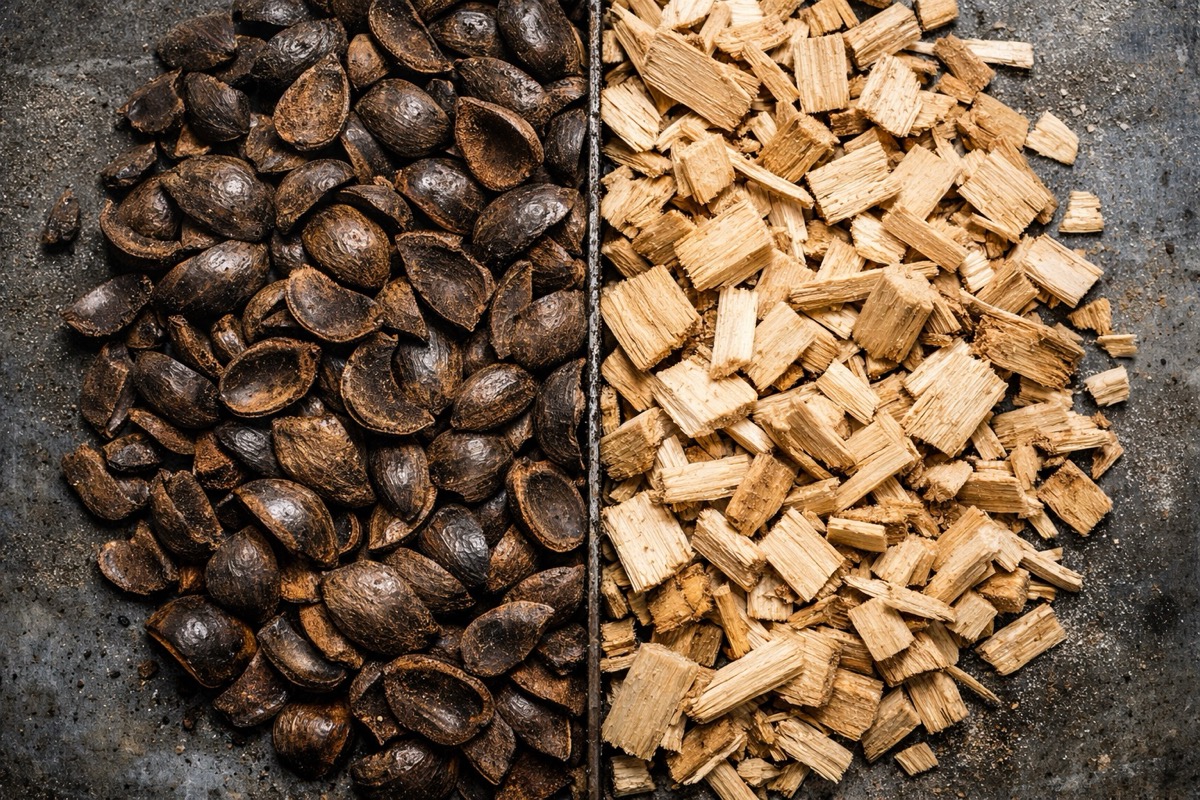
For operators running fluidized bed combustors, stoker boilers, and grate-fired installations, the biomass sourcing conversation is fundamentally different from the one being had at large pulverised-fuel power stations. Wood pellets — purpose-engineered for PF milling — are rarely the right specification. The real comparison for these operators is Palm Kernel Shell against wood chips: two bulk biomass commodities that both arrive loose, both burn on grates or in beds, and both compete on delivered energy cost at European industrial ports.
The differences between them, however, matter considerably for boiler efficiency, compliance documentation, supply chain reliability, and long-run procurement economics. This analysis covers each dimension in turn.
Calorific Value and Moisture: The Core Energy Comparison
Wood chips are highly variable in energy content because moisture is the primary driver — and moisture content at delivery can range from under 20% for dried chips to over 55% for fresh forest residues, depending on origin and processing. At 30% moisture, a typical industrial wood chip specification delivers around 11–13 MJ/kg on an as-received basis. At 50% moisture — common for primary forestry chips used in large district heating systems — this drops to 7–9 MJ/kg, nearly half the energy density of dry material. Drying infrastructure, whether at the plant or upstream, adds capital and operating cost that procurement teams do not always include in delivered cost-per-GJ calculations.
Certified PKS from Malaysia and Indonesia arrives at European ports with moisture typically in the 10–18% range. At this moisture level, PKS delivers 16–19 MJ/kg as-received, with well-managed supply programs consistently achieving 17.5–18.5 MJ/kg at the time of discharge survey. The practical implication is that PKS carries two to three times the usable energy per tonne of wet forest chips and 20–30% more than well-dried chips in the 25–30% moisture range.
For procurement managers comparing on a cost-per-GJ basis, this energy density difference substantially changes the arithmetic. A €5/tonne price premium for PKS over wet forest chips, for example, typically dissolves when expressed as cost per delivered GJ — and often inverts.
Combustion Behaviour and Boiler Compatibility
Wood chips and PKS both perform well in circulating and bubbling fluidised bed combustors (CFBC and BFBC), stoker systems, and moving grate designs. Neither requires the milling infrastructure that wood pellets need for pulverised fuel configurations. However, their combustion profiles differ in ways that matter to boiler operators.
Wood chips vary significantly in particle size and density depending on origin: forest residue chips (branches, tops) are irregular and may contain bark, stones, and soil contamination; clean stem chips from sawmill residues are more consistent. This variability creates challenges for bed material management in FBC systems and can cause grate-bridging in stoker designs if moisture is too high. Consistent chip specification requires either close supplier control or on-site screening, neither of which is free.
PKS arrives with naturally consistent particle geometry — the distinctive curved shell fragments are broadly uniform in size distribution and density across well-screened supply programs. This makes bed fluidisation behaviour predictable and reduces manual intervention requirements during startup and load changes. PKS has an ash fusion temperature above 1,200°C, which is compatible with standard ash-handling systems and significantly reduces clinker risk compared to some agricultural biomass alternatives. Sulphur content is typically below 0.08%, reducing SOx compliance exposure versus coal and many lower-grade biomass fuels.
Ash content is one area where PKS requires attention. PKS typically produces 1.5–3% ash on a dry basis — higher than clean stem wood chips (0.3–1%) but comparable to forest residue chips. The ash is manageable in standard cyclone and bag filter systems, though operators switching from clean wood chips should confirm ash handling capacity before increasing PKS blend ratios significantly.
RED II Compliance: Where PKS Has a Structural Advantage
Wood chips occupy a complicated position in the RED II compliance landscape depending on their origin. Chips from primary forests or sourced without verified sustainable forest management (SFM) documentation can be difficult to certify, particularly for buyers subject to the additional audit requirements introduced under Article 29 for installations above 50 MW. Forest residue chips require full chain-of-custody documentation demonstrating no-conversion-of-high-biodiversity-land, carbon stock compliance, and legality under country-of-origin forestry law. Meeting these requirements involves multiple certifications, and the documentation burden for spot procurement of diverse origins is substantial.
PKS is classified as a processing residue under RED II Annex IX Part B. This classification reflects its status as the hard outer shell of the palm kernel — a byproduct of palm oil processing with no commercial alternatives that would make it a co-product rather than a waste stream. The practical consequence is that PKS is not subject to the land-use criteria that burden wood chip supply chains. GHG calculations start from the mill gate rather than from land use, and lifecycle savings of 70–80% against the fossil fuel comparator are achievable with MSPO- or ISCC-certified supply — well above the 70% threshold applicable to existing co-firing installations from 2026.
For procurement managers who spend significant internal resource on sustainability documentation, the PKS compliance pathway is often simpler to manage. Our RED II documentation checklist sets out the full package of certificates, declarations, and survey reports that a compliant PKS cargo should carry. See also our complete guide to EU RED II and PKS compliance requirements.
Supply Chain: Volume, Geography, and Logistics
Wood chip supply chains are typically regional: Scandinavian and Baltic chips move by short-sea vessel to northern European ports, and central European chips travel by truck or rail from forestry operations within a few hundred kilometres of the plant. This proximity keeps freight costs low and delivery lead times short. However, regional supply is also more exposed to weather-related disruption, domestic demand spikes from district heating, and forestry policy changes — as Nordic operators discovered during the 2021–2023 period when domestic competition for forest residues intensified sharply.
PKS ships intercontinentally from Southeast Asia. The primary route — loading ports in Malaysia or Indonesia through the Strait of Malacca, Suez Canal, and on to Rotterdam, Amsterdam, or Ghent — takes approximately 25–32 days depending on the loading port and vessel transit schedule. This means buyers need to plan procurement 6–8 weeks ahead of discharge to ensure supply continuity. For operators maintaining 4–6 weeks of stockpile, this is manageable; for sites with limited storage and a just-in-time procurement model, it requires adjustment.
The supply base for PKS is geographically diverse across dozens of producing regions in Peninsular Malaysia, Sabah, Sarawak, Sumatra, and Kalimantan. No single origin accounts for a dominant share of export volume, and this geographic diversity insulates buyers against single-origin supply disruptions in a way that regional biomass supply chains cannot always match.
Which to Choose: A Practical Decision Framework
The PKS vs wood chips decision comes down to four factors for most FBC and stoker operators:
- Delivered energy cost: Calculate cost-per-GJ at your discharge port or plant gate, adjusting wood chip prices for actual moisture content. PKS is frequently competitive once moisture is properly accounted for.
- Storage and handling infrastructure: PKS requires covered dry storage (dome or warehouse) to maintain moisture specification. Sites with outdoor chip storage will need to assess whether covered PKS storage is feasible.
- Compliance documentation burden: If your compliance team currently manages complex wood chip origin documentation, PKS under a certified supply program often reduces ongoing administrative load.
- Supply security and blending strategy: PKS works well as part of a blended biomass strategy alongside locally-sourced wood chips, allowing operators to optimise on cost and maintain supply diversity.
For a comparison of PKS against wood pellets in pulverised fuel configurations, see our separate analysis: PKS vs Wood Pellets for European Co-Firing.
Evaluating PKS for Your FBC or Stoker Installation?
PKSEurope can provide delivered cost comparisons against your current biomass supply, full technical specifications, and sample documentation packages for compliance review.
Request Technical and Pricing Information